

Node-RED Automation Services for IoT and Industrial Workflows
Turn device events, gateway data, APIs, databases, and operator actions into visible workflows that can be tested quickly and operated responsibly.
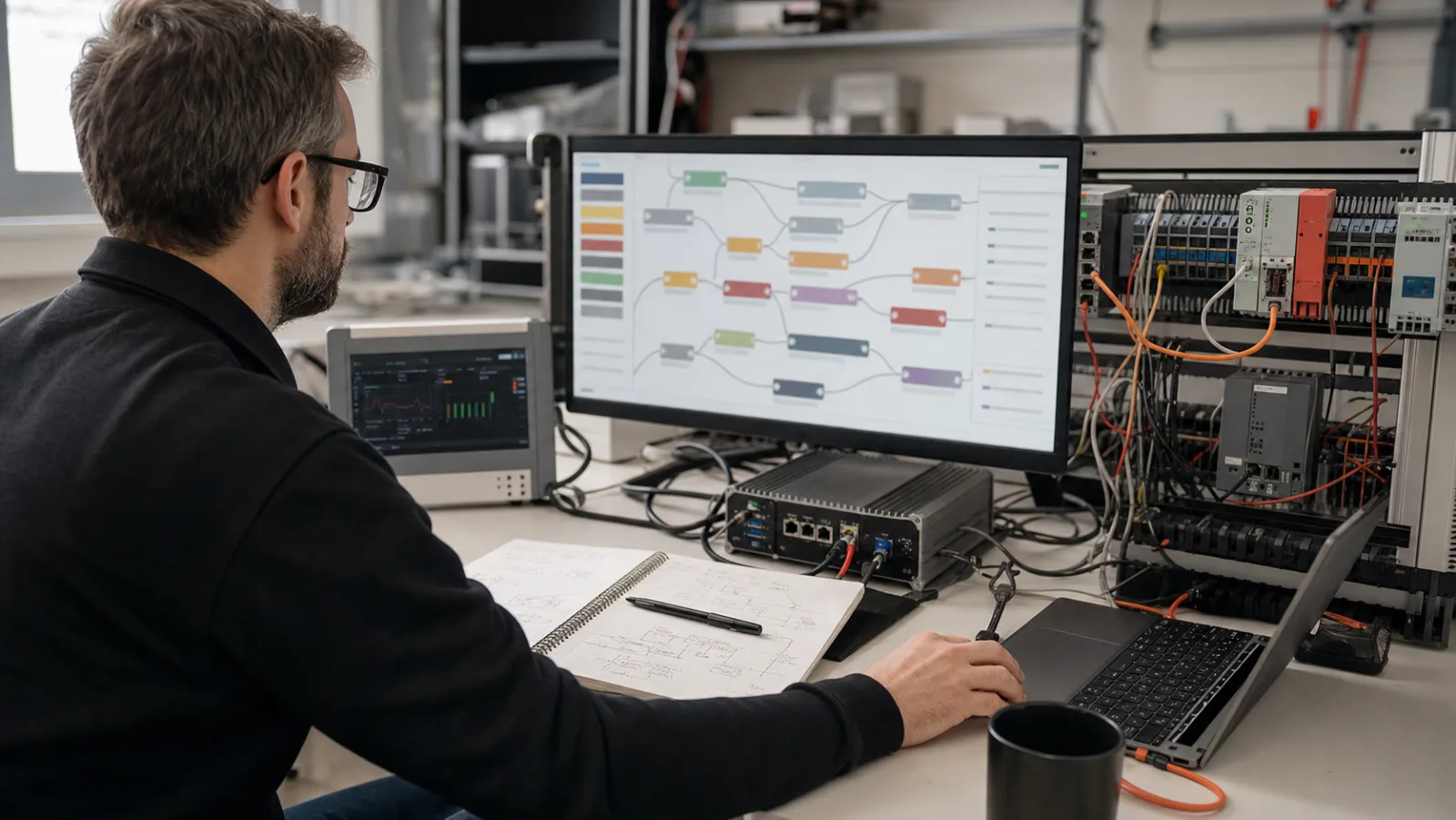
Fast visual integration still needs an operating model
Node-RED makes a workflow easy to see, but a production system still needs clear ownership, reusable logic, safe credentials, predictable errors, version control, deployment, observability, and recovery.
Integration complexity moves into the flow
Protocol differences, units, timing, retries, mapping, and error behavior must be made explicit instead of hidden in ad hoc nodes.
Manual intervention needs a controlled path
Operator actions, approvals, overrides, escalation, and audit evidence should be part of the workflow rather than informal side channels.
Real-time behavior needs recovery
Flows must survive service restarts, unavailable APIs, duplicate events, slow databases, credential changes, and field network loss.
From first workflow to a maintained automation runtime
We preserve the speed of flow-based development while adding the structure needed for repeatable deployment and support.
Custom workflow solutions
Model device events, decisions, transformations, schedules, approvals, notifications, and system updates as maintainable flows.
IoT device and cloud integration
Connect MQTT, Modbus, serial, HTTP, databases, cloud APIs, industrial systems, and customer applications.
Real-time data processing
Filter, normalize, enrich, aggregate, route, buffer, and persist field data close to the source or in the cloud.
Custom node development
Package proprietary protocols, business logic, reusable subflows, credentials, validation, and tests into governed nodes.
Keep field data, decisions, and business actions visible
A useful flow shows where data enters, how it is normalized, what rules are applied, where state is stored, and which human or system action follows.
Run Node-RED where the workflow needs to make decisions
Edge, cloud, and hybrid deployment each change latency, availability, security, support, and data ownership.
Edge gateway workflows
Run protocol adapters, local rules, buffering, data reduction, device commands, and store-and-forward close to equipment.
Cloud integration workflows
Connect brokers, APIs, webhooks, databases, SaaS tools, tickets, notifications, and reporting systems.
Managed automation runtime
Package flows, configuration, credentials, logs, backups, deployment, rollback, monitoring, and support procedures.
Make flows understandable to the next engineer
We structure the runtime so a customer team can identify what is running, what changed, why a flow failed, how to restore it, and what should be tested before the next release.
- Named flows and subflows with clear ownership and input/output contracts
- Custom nodes packaged with configuration, validation, tests, and versioning
- Environment-specific configuration and credentials kept out of flow exports
- Health checks, structured logs, correlation IDs, metrics, and alert thresholds
- Deployment, backup, restore, rollback, and dependency procedures
- Failure injection for APIs, brokers, databases, devices, and network interruptions
Use visual automation where it makes field-to-system logic easier to own
Node-RED works best when the flow accelerates integration without becoming an undocumented replacement for the product architecture.
Industrial data routing
Collect equipment data, normalize tags, apply local conditions, and forward useful events to operations systems.
Alarm and escalation flows
Turn sensor thresholds, device faults, or stale data into notifications, tickets, approvals, and follow-up actions.
API and business integration
Bridge device platforms with ERP, WMS, CRM, service tools, reports, and customer portals.
Rapid workflow validation
Prove a field-to-system workflow visibly before investing in a larger custom platform module.
Prove one field event through to one useful action
Start with the source device or API, the decision that matters, the target system, the failure cases, and the evidence the operating team needs.
Node-RED automation questions
Clarify deployment, maintainability, custom nodes, security, scale, and the boundary between a rapid flow and a long-term product service.
What can ZedIoT build with Node-RED?
We can build device and gateway flows, MQTT and API integration, protocol normalization, alarms, schedules, dashboards, database workflows, business-system connectors, custom nodes, edge processing, and operational automation.
Is Node-RED suitable for production systems?
It can be when the scope fits and the runtime is engineered properly. Production use needs controlled dependencies, configuration and credentials, logging, health checks, deployment, backup, rollback, tests, error handling, and ownership. It should not become an undocumented container for every product rule.
Should Node-RED run on an edge gateway or in the cloud?
Edge deployment suits low-latency device access, local rules, buffering, and intermittent networks. Cloud deployment suits cross-system APIs, central automation, and shared services. Hybrid designs can separate field continuity from central workflows.
Can you develop custom Node-RED nodes?
Yes. We can package private protocols, reusable integrations, business rules, device adapters, validation, configuration, credential handling, and tests into custom nodes or governed subflows.
How is Node-RED different from n8n?
Node-RED is commonly stronger for devices, gateways, MQTT, field protocols, and edge workflows. n8n is commonly stronger for business SaaS, API automation, approvals, and back-office workflows. Some systems use both at different layers.
What should a Node-RED pilot prove?
A pilot should prove one real input, the transformation or decision, the target action, failure and recovery behavior, logging, deployment, and whether the operating team can understand and support the flow.
Discuss a Node-RED workflow
Share the devices or APIs, current data path, decisions and actions, deployment environment, failure cases, and target systems. We will help define a maintainable first flow.
- AI + IoT product architecture review
- Hardware, firmware, cloud, and application integration
- Prototype planning and production support